Blog
The note field was always there and it was always empty
A badge scan returns a registration row typed months ago, and the note field meant to hold everything else stays blank for a reason nobody writes down.
Every badge scanner sold to an exhibitor does one thing well and one thing not at all. It reads a barcode, returns a name, a company, a job title and an email address, and writes that row into a lead list. Then it offers a note field, and the note field is where booth conversation capture is supposed to happen.
It almost never does. The field is not broken and the staff are not careless. It goes unused for a reason that lives in the structure of a show floor rather than in anyone’s discipline, and until that reason is named, every product built on top of the note field inherits it.
What a badge scan contains
A scan returns the fields an attendee typed into a registration form, often months before the doors opened. Name, company, job title, email, sometimes an industry dropdown and a reason-for-attending checkbox. That data is accurate, portable, and entirely indifferent to whatever the two of you said at the counter.
A badge scan is a lookup, not a record. The barcode or NFC chip on a badge holds an identifier; scanning it pulls the registration row attached to that identifier out of the organizer’s database and drops a copy into the exhibitor’s lead list. Everything in that row was typed by the attendee during registration, which for a large share of any show’s audience happened weeks or months earlier. Jonas Event Technology, in an analysis of more than 130,000 registrations presented by its managing director Sarah Cox, found that people who register 12 or more weeks ahead attend at 18 percent while final-week registrants attend at over 50 percent, so the row and the person in front of you can be separated by an entire season. What a badge scan cannot contain is the reason the conversation mattered: the deployment they described, the objection they raised, the competitor they named, the timeline they mentioned twice without being asked.
Cvent states the consequence plainly: if there’s no context to these conversations, it’s hard to tell which leads are worth pursuing. allintheloop publishes under the headline that a badge scan tells you who they are, it doesn’t tell you why they matter. Eight or more articles in this category make the same argument and end at the same place, which is a recommendation to buy the author’s software. None of them asks the prior question.
Why the note field stays empty
Because writing in it is an action, and the action competes with the conversation it is meant to describe. Every capture method a scanner app offers, whether typing, a voice memo or a qualifier dropdown, asks the staffer to divide attention at the moment the visitor is deciding whether this booth deserves the next twenty minutes of their afternoon.
A booth conversation has a shape. Someone stops walking, looks up, and asks a question. The staffer has about four seconds to be fully present before the visitor forms a verdict. Typing into a note field spends those four seconds, and it spends them at the front of the exchange, where they are worth the most. So the staffer defers it. The next visitor arrives before the deferral is repaid.
This is the same cost we described when explaining why the best device is the one you never wear: the recording succeeds and the conversation degrades, which is the wrong trade, because the conversation was the asset. A note field is a lighter version of the same demand. It is still a demand.
The second failure is quieter. On the third hour of the third day, the staffer does not consciously decide to skip the note. They intend to write it later, and later never has a gap in it. Nobody discovers the loss until the follow-up list is short and no one can reconstruct why.
The window everyone is arguing about
momencio argues that the practical window for capturing what was said is 60 to 90 seconds after the visitor walks away. That is a vendor’s assertion published on a vendor’s blog, with no study behind it. It is worth repeating because it is the figure the category argues over, not because anyone has established it.
Grant it anyway, because the argument gets more interesting when you do. A 60-to-90-second window is not free time. At a busy counter it is occupied by the next person, by a colleague asking who that was, by the walk to the coffee station that the staffer has been postponing since the morning. The window exists in the same sense that a parking space in a full lot exists — technically, and not for you.
More to the point, a window is a description of decay, not a mechanism for preventing it. Naming the interval tells an exhibitor how fast the memory degrades. It does not tell them who is going to be free during it. Every product that quotes the window then proposes the same remedy, which is a faster interface for the person who did not have time for the slower one. That is a question worth putting to any supplier directly, alongside the nine questions we would ask a capture vendor.
The one field observation anybody has published
There is exactly one piece of field data in this space that came from someone counting rather than estimating, and it is nearly a footnote. Bob Milam ran informal exit interviews at an Institute of Food Technologists show, asking departing attendees whether an exhibitor had promised to follow up with them.
Recorded by Zuant, the result was that 850 attendees said a follow-up had been promised, while fewer than 150 of those promises had been written down anywhere. The gap is not a follow-up failure. It is a recording failure that happened hours earlier — before anyone could have failed to follow up. Seven hundred conversations reached the moment of commitment and left no trace.
What happened next is the part usually left out. Milam’s remedy was to appoint what he called a Lead Sheriff, a person whose job was to walk the booth and make sure promises were captured. Recorded promises went from about 150 to more than 700 in a single year.
Read that as a solved problem and you miss it. The fix worked by adding a human being whose entire function was the labor nobody else had time for. The labor did not disappear; it was reassigned to someone with no competing conversation. Most exhibitors cannot staff a person to that role, and the ones who can are paying show-floor headcount rates to transcribe what was already spoken aloud in the room. That is the shape of the problem: it is not a discipline problem, and it responds to structure. It also does not respond to structure that only listens to one table at a time, which is a separate constraint we treat in two conversations at one counter.
What the follow-up numbers say, and who said them
The published figures on trade-show follow-up are thin, mostly undated, and almost never traceable to a primary document. These are the ones with a name attached, presented with that name in the row rather than in a footnote, because the attribution is the only thing separating them from folklore.
| Figure | Who said it | Where and when |
|---|---|---|
| At least 40 percent of leads generated on the show floor go unfulfilled | EXHIBITOR magazine’s Sales Lead Survey | Quoted by Zuant, December 2018; no year given for the survey itself |
| 79 percent of leads gathered at events never receive a follow-up | Sarah Cox, managing director of Jonas Event Technology | Event Tech Live 2025 |
| 850 attendees reported a promised follow-up; under 150 promises were recorded | Bob Milam, informal exit interviews | Institute of Food Technologists show, year not stated |
| Recorded promises rose from about 150 to more than 700 in one year after a Lead Sheriff was appointed | Bob Milam, same study | Same show, following year |
| Registrants 12+ weeks out attend at 18 percent; final-week registrants attend at over 50 percent | Jonas Event Technology, 130,000+ registrations | Analysis presented at Event Tech Live 2025 |
| 83 percent of organisers believe sessions drive return intent; 42 percent of attendees agree; 27 percent return the next year | Freeman Spring 2026 Learning Trends Report, 4,729 attendees and 185 organisers | Published Spring 2026 |
Two of these rows describe the same failure from opposite ends. EXHIBITOR’s survey counts leads that were captured and never worked. Milam counted conversations that were never captured at all, which means they never entered the denominator EXHIBITOR was measuring. The second number is invisible to the first, and it is larger.
What has to be true for the record to survive
For a booth conversation record to still exist on the last day of a show, three things have to hold — and none of them is a feature of the note field. Capture cannot require a staff action. It has to distinguish who was speaking. And it has to be honest to the visitor without anyone remembering to be.
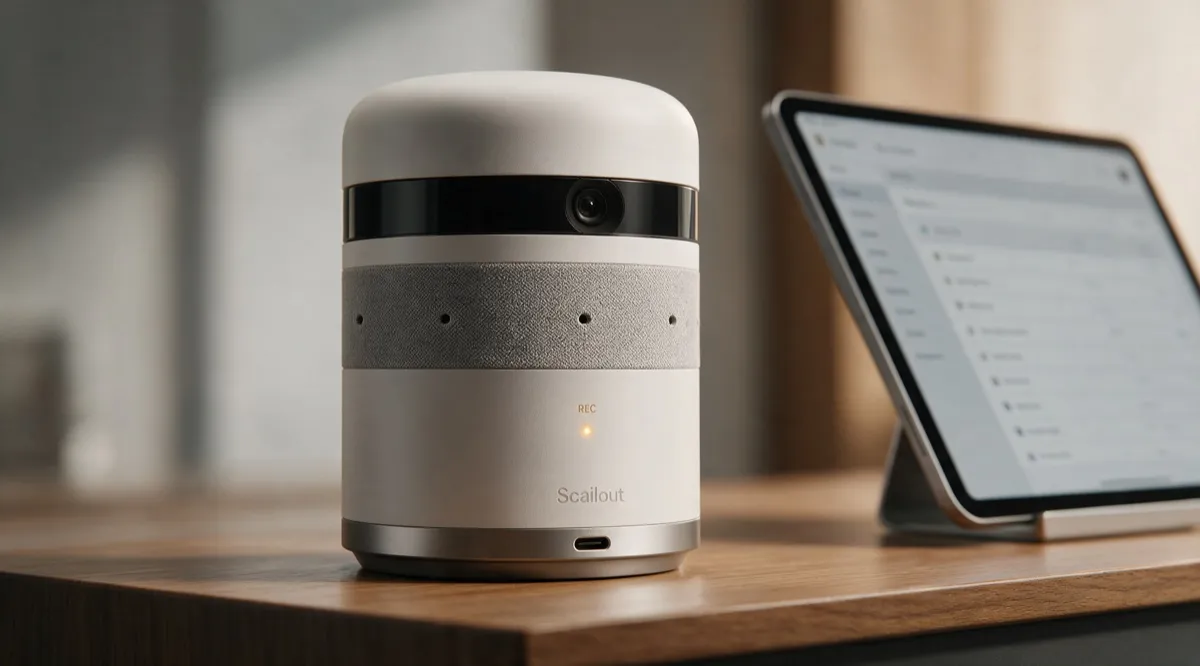
The first is a design rule rather than a preference. If capture depends on someone pressing, typing or remembering, then the record’s completeness is a function of how tired that person is at 4pm on day three. Scailout Station is fixed to the counter and runs on booth power for that reason: nothing starts it, stops it, charges it or is meant to be remembered.
The second is why position matters more than sensitivity. A device placed to hear one counter can separate simultaneous conversations and attribute each to the right visitor, rather than collapsing a booth into a single undifferentiated file. That placement also sets a hard boundary on what the device can reach, which we treat as a feature in the distance limit is the privacy feature and account for honestly in what booth-fixed capture cannot do.
The third follows from the first. If the staffer never manages the capture, the duty of disclosure cannot land on the staffer either. It has to be built into the object, which is why the recording indicator has no off switch and why we wrote the recording light with no off switch before writing anything about accuracy. The rules that govern this vary sharply by country and by US state, and we set them out in booth recording consent by jurisdiction.
What we are not claiming
The most-cited statistic in this industry is that roughly 80 percent of trade-show leads are never followed up, and it is almost always attributed to CEIR, the Center for Exhibition Industry Research. We went looking for the report and could not find one. The figure has no publisher we can name.
CEIR’s published research catalog lists eight titles, including the Exhibition Index, How the Exhibit Dollar is Spent, and the Organizer Benchmarking Study. None of them concerns lead follow-up, lead quality or exhibitor lead management. One secondary source attributes the identical figure to Salesforce in 2012 instead.
We could not trace it, so we do not use it. Cox’s 79 percent is close enough in magnitude to be tempting as a substitute citation, and it is a different claim from a different speaker about a different population; we cite it as hers and leave it there.
We also publish no cost-per-lead figure. Six mutually contradictory values circulate in this category, ranging from about 112 dollars to several hundred, with attributions that conflict with each other and no locatable primary source behind any of them. A number that changes depending on which blog you read is not a number.
And we publish no performance figures for our own device, because it has not been measured in an exhibition hall. What we have is a set of requirements derived by calculation and a design that follows from them. When there are measurements, they will appear with the conditions they were taken under.
The field can stay empty. Something else has to be full.