Blog
Recording it is legal and keeping it may not be
Korean law splits one booth conversation across three statutes. Clearing the first does not clear the other two, and the burden of proof sits with the exhibitor.
A conversation at your booth in Seoul goes well. The visitor leaves a business card. The device on the counter has kept all eight minutes as a file. Nothing about that is unusual at a Korean trade show. What is unusual is how many separate statutes just attached themselves to one file.
Booth recording consent in Korea is not one question with one answer. Foreign exhibitors arrive expecting a single rule, the way California has one and Nevada has another. Korean law instead splits the situation by layer: the act of recording sits under one statute, the file that results sits under a second, and the email you send afterwards sits under a third. Clearing the first tells you nothing about the other two.
This article is general information, not legal advice. It summarises publicly available statutes as of the visible publication date. Recording law differs by country, by state, and by whether a conversation happens in person or over a phone, and it is changing quickly. Confirm your own situation with qualified counsel before recording anyone.
Jurisdiction scope. This article covers the Republic of Korea only. For a side-by-side of Korea, the EU, California and Nevada, see how booth recording rules split by jurisdiction. What follows is the Korean stack in depth, with article numbers and enforcement dates.
Booth recording consent in Korea means three consents, not one. The first layer asks whether the conversation may be recorded at all, and the statute is the Protection of Communications Secrets Act (통신비밀보호법). What that act prohibits is recording a conversation between other people that has not been made public, at Articles 3(1) and 14(1), in force 1 August 2025. The second layer asks whether the resulting file may be kept and used, and that is the Personal Information Protection Act (개인정보 보호법). Purpose, categories, retention period and the right to refuse must all be disclosed before consent, and the burden of proving that personal data could be processed without consent falls on the business, at Articles 15(1), 15(2) and 22(3), in force 2 October 2025. The third layer is the follow-up email, governed by Article 50(1) of the Network Act, in force 7 July 2026. Each layer has its own enforcement date, so a notice written once does not stay correct.
What the wiretap statute actually prohibits
A booth rep recording a conversation they are themselves sitting in is not the case the Communications Secrets Act describes, because the prohibition reaches a conversation between other people. The rep is a party to it. A device on the same counter that keeps running while no rep is in the conversation is a different matter entirely.
Those two sentences belong together and separating them produces a dangerous conclusion. When two visitors stand beside your counter talking to each other and the device is still capturing, that is a recording of a conversation between other people. Article 16(1) attaches. The penalty is imprisonment of not less than one year and not more than ten, with suspension of qualifications for up to five years. The floor is prison, not a fine. Article 16(1) item 2 separately punishes anyone who discloses the contents obtained that way, which reaches the habit of pasting a transcript into a team channel.
A booth counter sits exactly on that line. The words of the person seated at the table and the words spoken a metre behind them arrive at the same microphone. When two conversations run at one booth, the problem is not only transcript quality. Which parts of the file are party recordings and which are not gets mixed inside a single file. That is why the always-on design looks easiest and is riskiest.
Article 3(1), quoted, and what it leaves undefined
Article 3(1) reads, in the official Korean: 누구든지 이 법과 형사소송법 또는 군사법원법의 규정에 의하지 아니하고는 우편물의 검열ㆍ전기통신의 감청 또는 통신사실확인자료의 제공을 하거나 공개되지 아니한 타인간의 대화를 녹음 또는 청취하지 못한다. Article 14(1) restates the same prohibition for conversations specifically. Both are readable in full at 국가법령정보센터, the government’s own legal database, version in force 1 August 2025.
What matters most is what the statute does not say. Article 2 defines 통신, 우편물, 전기통신, 당사자 and 감청. It does not define 대화, conversation itself. The definition of 당사자, party, at Article 2 item 4 covers postal matter and telecommunications and does not extend to conversations. No article in Korean law states that party recording is permitted. There is only an article prohibiting the recording of conversations between other people, and everything else sits outside that prohibition rather than inside a permission.
The phrase 공개되지 아니한, not made public, is undefined in the same way. No provision tells you whether a given booth exchange qualifies. An open counter facing a main aisle and a three-walled meeting room inside the same booth are not the same condition. This is one more reason to map what booth-fixed capture covers and where it stops as geometry. The coverage boundary is also where the legal characterisation changes.
The four disclosures the privacy act requires
Clearing the first layer does not let you keep the file. A recording carrying a voice, a name and a company is personal data. Article 15(1) of the Personal Information Protection Act lists seven lawful bases and item 1 is the data subject’s consent. Relying on consent means disclosing the four items in Article 15(2) before you take it.
The four are the purpose of collection and use, the categories of personal data to be collected, the retention and use period, and the right to refuse consent together with any disadvantage that refusal causes, in force 2 October 2025 at 국가법령정보센터. Most booth signage states the first item and omits the other three. The fact that recording is in progress is not a category, not a period, and not a right to refuse.
Article 17(2) attaches separately once the file leaves your company. Five further disclosures are required: the recipient, the recipient’s purpose, the categories provided, the recipient’s retention period, and the right to refuse with its consequences. Any architecture that ships transcripts to a vendor cloud or into a partner CRM lands here. That is the provision behind putting where the audio is processed at the top of the questions to ask a capture vendor.
Article 22 governs how consent is taken. Paragraph 1 requires each consent item to be separated and made clearly recognisable, which blocks bundling recording consent and marketing consent into one checkbox. Paragraph 5 prohibits refusing service because someone declined optional consent, meaning you cannot tell a visitor who declines recording that you therefore cannot talk to them.
The sharpest sentence sits in Article 22(3): 동의 없이 처리할 수 있는 개인정보라는 입증책임은 개인정보처리자가 부담한다. The burden of proving that personal data may be processed without consent rests on the data controller. Believing the visitor consented is not enough. The business must be able to demonstrate it. After three days and several hundred visitors, how that demonstration was preserved is the whole practical question.
Three statutes, one table
The three statutes regulate different objects and demand differently shaped consents. That is why a single consent form fails to cover a booth. Set out with article numbers and enforcement dates, each layer’s meaning at the counter separates cleanly. All source text is at 국가법령정보센터.
| Statute | What it prohibits | What it means at the booth | Articles |
|---|---|---|---|
| 통신비밀보호법 (Communications Secrets) | Recording, or listening by mechanical means, to a non-public conversation between other people | A device capturing visitors talking to each other, with no rep in the conversation, lands here. The penalty floor is imprisonment | Art. 3(1), 14(1), 16(1), in force 1 Aug 2025 |
| 개인정보 보호법 (Personal Information Protection) | Collecting or using personal data without disclosing purpose, categories, period and right to refuse | Keeping and using the recording and its transcript needs its own consent. The business carries the burden of proof | Art. 15(1), 15(2), 17(2), 22(1), 22(3), 22(5), in force 2 Oct 2025 |
| 개인정보 보호법, fixed visual devices | Use of the audio-recording function on a fixed visual data processing device | A fixed device with a camera may not use a microphone. An audio-only device is outside this article’s scope | Art. 25(5), in force 2 Oct 2025 |
| 정보통신망법 (Network Act) | Sending commercial advertising without the recipient’s explicit prior consent | Post-show email and SMS need a consent distinct from the recording consent | Art. 50(1), 50(3), in force 7 Jul 2026 |
The third row is the one most easily misread. Article 25(5) tells operators of fixed visual data processing devices that the audio-recording function may not be used, with no exception and no balancing test. Because the article governs visual devices, an audio-only device with no camera falls outside its scope. Outside its scope is not the same as permitted. What remains is that in the single place where Korea legislated about a fixed recording device in a public space, it banned the microphone outright. An audio-only device instead stands on the general collection rules of Article 15.
Article 50(3) of the Network Act adds one more condition. Sending commercial messages between 9pm and 8am requires separate prior consent of its own. Consultation consent, marketing consent and night-transmission consent are three different consents.
The standard guidance says nothing about exhibitions
Here is something we checked ourselves rather than read about. The Personal Information Protection Commission’s standard guidance, 개인정보보호지침, issued as 훈령 제115호 and in force 30 April 2024, was retrieved in full and searched. 전시 (exhibition) zero hits. 이벤트 zero. 녹음 (recording) zero. 음성 (voice) zero. 행사 appears four times, always inside 권리행사, the exercise of rights.
Korea’s standard privacy guidance does not address the trade-show booth. This is a verified absence rather than a failure to find something. An exhibitor who went looking for official guidance on booth recording and came back empty-handed was searching correctly. The item is not in the guidance.
An absent standard also means the judgement transfers to the business. Read alongside the Article 22(3) burden of proof, the weight is clear enough: there is no guidance setting the bar, and the obligation to prove compliance sits with you. What was disclosed at the booth and when has to survive in operational records, not in the device.
Why the indicator has no off switch
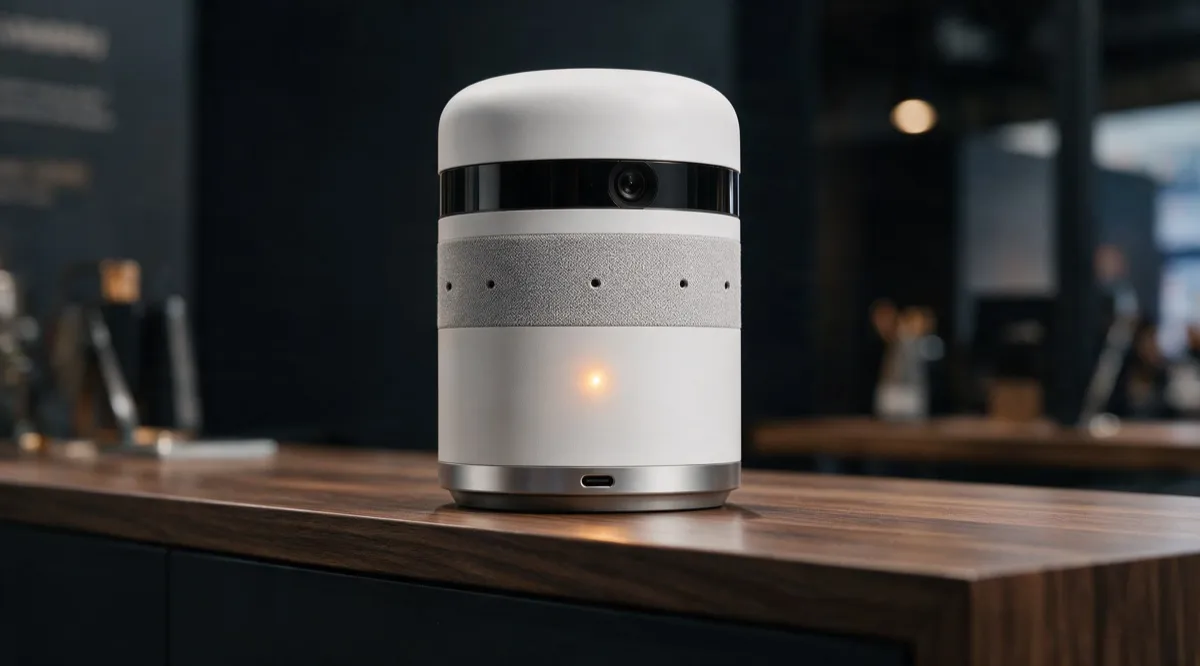
The booth-fixed device we are building carries a recording indicator that cannot be switched off while the unit is powered, not even in software. That design does not make anything lawful. Lawfulness comes from the disclosures and consent Articles 15 and 22 require, and the proof of it comes from people and documents.
What the indicator does is narrower. It puts the device’s state in front of a visitor before the conversation starts, visibly, without depending on whether anyone remembered to mention it. A recording light with no off switch does not leave that to a rep’s memory on the third afternoon of a three-day show. Reps forget. The object does not.
The same reasoning produced a device nobody wears. A microphone attached to a person walks into the aisle, into a competitor’s booth, and into the evening reception, and none of those places has a threshold where a notice can hang. A device fixed to the counter never leaves the area it points at. Not because that is easier to regulate, but because it has an edge that can be drawn.
The design did not follow from reading the statutes. The order was the reverse. The constraint came first, that nobody wears anything and nobody presses anything, and only afterwards did we hold the resulting object against three Korean statutes to see where it caught. It caught on operations, not on hardware. Who writes the notice, when the visitor sees it, and where the evidence of consent is kept.
Three layers, restated. Recording as an act is the Communications Secrets Act. Keeping and using the file is the Personal Information Protection Act. The follow-up email is the Network Act. The most common mistake at a Korean booth is letting relief about the first layer obscure the other two, which is also why the empty note field turns into a compliance problem and not only a lost-context problem. When the conversation is gone and only the card remains, the temptation is to stretch what that card consented to. Article 22(3) puts the cost of that stretch on the exhibitor. This article states the law as of 28 August 2026, and the law keeps moving after that.