Blog
A badge scanner and an AI notetaker have never competed
Three product categories are sold to the same booth team as one thing, and the clearest evidence that they are not is a word that appears in only half of their published pages.
Three products end up on the same booth counter, and every one of them is sold to you as lead capture. One reads badges. One records a conversation. One is a laptop somebody opened before sitting down. You put them in a spreadsheet, compare them on price, accuracy and integrations, and the spreadsheet returns an answer that does not mean anything.
The comparison that goes wrong most often is badge scanner vs AI notetaker. It goes wrong for a reason you can verify in an afternoon: the two halves of this market do not share a vocabulary, and neither half writes about the other.
Badge scanners, AI notetakers and capture stations answer three different questions. A badge scanner is a lead-retrieval tool. It reads an attendee’s badge, card or QR code and writes an identified contact into a form, with typed or dictated notes attached to it. An AI notetaker is a recording tool. It takes audio from a phone, a laptop or a worn device and returns a transcript and a summary of one conversation. A capture station is a third thing, fixed equipment installed in the booth that hears the counter it points at for the length of a show. The first answers who came by. The second answers what one rep and one prospect discussed. The third answers what was said across a counter over three days. Ranking a scanner against a notetaker on accuracy is ranking a directory against a recording, and the number you get out is not comparable to anything.
Who came by
A badge scanner answers one question directly: who stopped here, and what is their contact record. Cvent’s LeadCapture page describes scanning badges or business cards to capture contact details, notes and lead ratings, and adding qualification answers in real time.
iCapture describes a badge scan, a business card, a photo or manual entry all routing into the same form.
The hardware story in this category is that there is no hardware. Cvent’s iCapture page states that you run it on your own phone or tablet with no extra hardware or rental fees, and that it integrates with more than 130 badge providers. Zuant’s site describes lead retrieval at events, showrooms and trade shows, done from staff phones, with App Store and Google Play links as the whole install. Popl’s own comparison page describes reading event badges, paper business cards, LinkedIn QR codes and digital cards, and states that no developer kits are required.
Pricing splits the category cleanly between the vendors who publish and the vendors who do not. momencio publishes three tiers at $100, $130 and $170 per seat per month, billed annually, with a stated minimum of five seats and a starting figure of $6,000 per year, under terms that read: all subscription plans require a minimum 12-month commitment. Popl publishes nothing and says why, stating that it quotes pricing over a meeting instead of publishing it on the website. Cvent and Zuant publish no figures either. On its own comparison page, which sets Popl against Cvent, Captello and iCapture, Popl characterises iCapture as starting at around $8,000 per year. That is a competitor’s characterisation of a competitor’s price, published by Popl, and it should be read as exactly that. We could not fetch Captello’s own pages, so no Captello claim appears anywhere in this post.
What every one of these products captures is identity plus whatever a human typed. The industry already knows where that breaks. allintheloop publishes under the headline that a badge scan tells you who they are, it doesn’t tell you why they matter. Sarah Cox, MD of Jonas Event Technology, told Event Tech Live 2025 that 79% of leads gathered at events never receive a follow-up. The note field on a scanned badge is the part that was always empty, and no scanner in this category is designed to fill it for you.
What one rep and one prospect discussed
An AI recorder answers a different question, and its published specifications tell you exactly which one. The category competes on microphones and distance. Plaud’s Note Pro page describes four MEMS and one VPU microphone and voices captured up to 16.4 ft. Bee publishes dual microphones, a $49.99 price and seven days of battery life per charge.
The rest of the category reads the same way. Plaud’s NotePin page publishes two MEMS microphones, pickup up to 9.8 feet, 20 hours of continuous recording, 40 days of standby, 64 GB of local storage and a $159 regular price against a $110.99 sale price. The Plaud Note pages publish two MEMS and one VPU, an effective recording range of 9.84 ft, and one long-press to record. Bee’s page carries the strongest processing statement anyone in this set publishes: we never store audio recordings, processed in real-time, immediately deleted after processing.
Limitless is the cautionary entry and belongs in any current comparison with its date attached. Limitless states that it has been acquired by Meta and that it is no longer selling the Pendant as of December 5, 2025, with service ended in Brazil, China, the EU, Israel, South Korea, Turkey and the UK. Anyone in Seoul or Berlin reading a 2025 recommendation of it is reading about a product they cannot buy. Its Pendant FAQ also carries the clearest hardware sentence in this category: for privacy reasons, there is no way to dim or turn off the light entirely.
Software recorders sit alongside the hardware and publish the same kind of thing. Otter publishes no recording device at all; its capture inputs are web and mobile recording, and audio from a built-in mic, Bluetooth or AirPods, priced at $0, $16.99 and $24 per user per month. Granola publishes $0, $14 and $35 per user per month and describes walking meetings, conferences or coffee catchups on the phone apps, with the desktop product using your computer audio. Fireflies publishes $0, $18, $29 and $39 per seat per month, and its pricing page does not mention in-person or on-site recording at all.
Otter is also the fairest available source on where this category struggles, because it is Otter describing the problem on Otter’s own blog. Voices farther from the device get faint or cut out, it writes, and without distinct audio channels for each person, speaker attribution falls apart. Otter also states that it offers 95% accuracy levels — a claim Otter makes about Otter, on Otter’s site, not measured on any show floor. On consent it is direct: check consent laws in your jurisdiction and always announce that you are recording, and note that most U.S. states follow one-party consent while some require all-party consent. The reason that instruction lands on a person rather than a device is the whole design difference between these categories.
The word that appears in only half of these pages
Audio is the word. Across every lead-capture page we fetched, Cvent LeadCapture, Cvent iCapture, momencio, Zuant and Popl, audio recording is not mentioned once. Popl’s four-way comparison table, which sets Popl against Cvent, Captello and iCapture, contains no audio row at all.
Four major lead-capture products, compared feature by feature, and conversation audio is not a dimension anyone competes on.
The absence runs in both directions, which is what makes it evidence rather than an oversight. The recorder pages publish microphone counts and pickup ranges and do not mention CRMs, badges or lead forms. The lead-capture pages publish CRM routing, badge-provider counts and qualification questions and do not mention microphones. Neither half is hiding anything. They were built for different buyers, in different rooms, to answer different questions.
| What question it answers | What it captures | What its published pages say about audio |
|---|---|---|
| Who came by (Cvent LeadCapture) | Contact details, notes, lead ratings, qualification answers | Audio is not mentioned on the page |
| Who came by (Cvent iCapture) | Badge scan, business card, photo or manual entry into one form; 130+ badge providers | Audio is not mentioned on the page |
| Who came by (Zuant) | Badge, QR and check-in data captured from staff phones | Audio is not mentioned on the page |
| Who came by (Popl) | Event badges, paper business cards, LinkedIn QR codes, digital cards | Not mentioned on the pricing page, and no audio row in its own four-way comparison |
| Who came by, with dictation (momencio) | Notes captured by speech-to-text or typing, synced to the lead profile | Described as speech-to-text; audio storage is not mentioned |
| What one conversation contained (Plaud Note Pro) | Audio from four MEMS and one VPU microphones, up to 16.4 ft | Published in detail; CRM destination is not mentioned on the pages fetched |
| What one conversation contained (Bee Pioneer) | Audio from dual microphones, $49.99 | Never stored, per Bee: processed in real-time, immediately deleted |
| What one conversation contained (Otter) | Web and mobile recording, built-in mic, Bluetooth, AirPods | Published in detail; no recording hardware is offered |
| What was said across a counter (Scailout Station) | Booth-counter conversation, from fixed equipment on booth power | Not published. We have measured nothing and print nothing |
The last row is deliberately thin, and the rest of this post explains why it stays that way.
The one product standing on the line
Blinq is the exception that proves the boundary is real rather than imagined, because it is the single product in this research that answers both questions at once. Blinq describes capturing your conversations, transcribing them, and creating an AI summary linked to who you met, with card swaps during a recording linking the note to the new contact automatically.
It runs where the lead-capture category runs, not where the recorder category runs. Blinq publishes iPhone, Android, Apple Watch, Wear OS and a paired Bluetooth mic as its capture surfaces, and states that a single note can be up to 8 hours. On storage it is specific: for in-person notes, audio is stored securely on its systems until you delete the note, encrypted in transit and at rest, on Google Cloud, and never used to train AI models. Premium is $9.99 per month and Business $6.99 per user per month.
Blinq is also the most explicit vendor in the lead-capture category on consent, and it puts the duty where its architecture requires it to sit. You are responsible for getting consent from everyone you speak with, its page reads, with every user accepting a consent commitment before their first note and seeing reminders in the app while capturing. It even publishes the script: mind if I record our chat using Blinq AI Notetaker. Those reminders are shown to the person recording. An indicator shown to the other party is not mentioned on the page, which is not a criticism of Blinq so much as a property of running on a phone in someone’s hand.
Why the wrong comparison keeps happening
The comparison keeps happening because almost every comparison in this space is written by one of the products in it. Popl compares Popl to three competitors. momencio, BoothIQ, Tendro, Mobly and Wave Connect all publish pages on Cvent alternatives. Plaud publishes its own page against Limitless.
Every one of those pages ranks its author first, and none of them crosses the boundary, because crossing it means admitting your product does not compete with half the list.
The result is a buyer holding two spec sheets that cannot be laid over each other. One lists badge providers, CRM fields and seat minimums. The other lists microphone counts, pickup distances in feet and battery hours. There is no shared row, so the buyer invents one — usually accuracy, or price per user — and picks the wrong product for the question they actually have. The nine questions worth asking any capture vendor are all mechanism questions for exactly this reason. Where is the audio processed, what does the indicator do, who can switch it off.
Ask which question you have first, and the shortlist writes itself. If you need to know who came by and route them into a CRM, the lead-capture category is built for that and has been for years, and a recorder will not do it. If you need one rep’s one meeting written up, a recorder does that on a phone or a lapel, at the cost of somebody starting it. If you need to know what was actually said at your counter across three days, neither category was designed for the question, and the honest answer is that a booth is a hard acoustic room before it is a product decision.
The third question
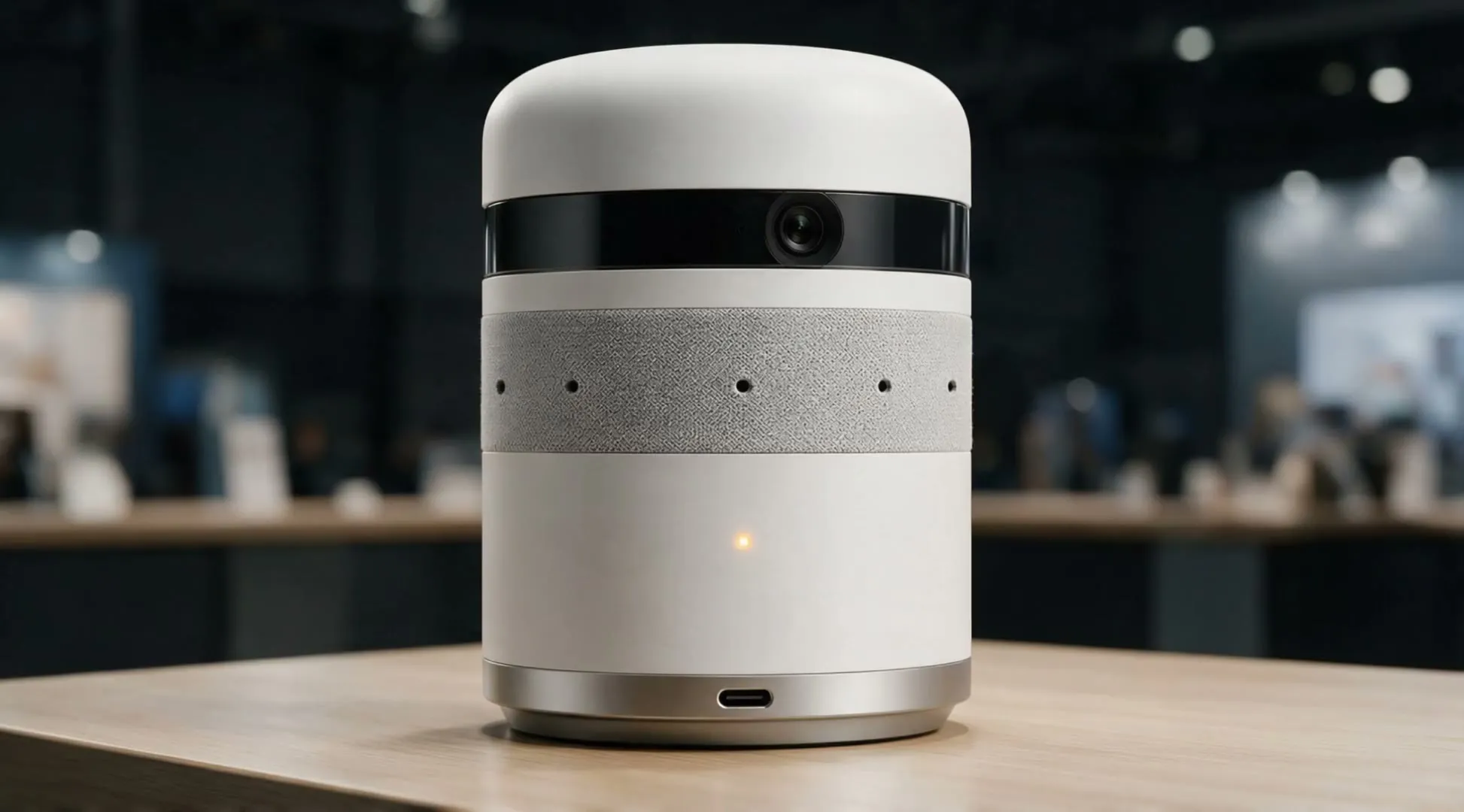
The third question is the one we build for, and it is narrower than either of the other two. A capture station is fixed to the booth counter, on booth power, aimed at the seats it was placed to hear. Nobody wears it. Nobody starts it, stops it, charges it or remembers it.
It carries a visible recording indicator with no off switch, which is a design position with public precedent rather than an invention of ours. Limitless published the same choice in hardware, and Zoom publishes it in software for guest participants.
Everything else in our column of that table is blank, and it stays blank on purpose. We publish no accuracy figure, no pickup range, no microphone count, no battery number, no customer outcome. Plaud publishes 9.8 ft, 9.84 ft and 16.4 ft because Plaud measured something. We have not, so the cell stays empty, and the limits of this form are worth reading before the strengths. An empty cell in a comparison table is an unusual thing for a vendor to ship. It is also the only cell we can defend, and the distance the equipment can resolve is a constraint we chose rather than a score.
So the answer to badge scanner vs AI notetaker is that you probably need one of them, and the reason you cannot choose between them is that they were never in the same race. The rule that produced our form forbids us from entering the other two. A scanner tells you a name. A recorder tells you a meeting. What happened at the counter on the second afternoon, between two people who sat down, is a third thing, and nobody has been selling it.