Blog
Every recording starts with somebody looking away
Sort every conversation-capture product by the action a person has to take before the recording exists, and the category rearranges itself into a list nobody publishes.
Every AI notetaker start recording mechanism sold for in-person conversations is published somewhere on the vendor’s own page, in the vendor’s own words. Plaud publishes a long-press. Bee publishes a button press. Blinq publishes a start, a pause and a stop. Otter publishes an app and a sentence you are supposed to say out loud.
Read enough of those pages and they sort themselves. Not by accuracy, which nobody outside the vendors has measured at a trade show, and not by price, though the prices are in the table below. By the size of the action the product asks for at the exact moment a stranger stops walking and asks a question.
Who has to press record on an AI notetaker
On almost every product in this category, a human being does. The vendors say so themselves, in the specification sections of their own product pages, using their own words. The differences between them are differences in how many taps, how long a press, and whether anything stops on its own.
A start mechanism is the physical or on-screen action a capture product requires from its user before audio is recorded, and it is the one attribute every vendor in this category publishes plainly. Plaud’s Note page describes it as “One long-press to record,” with “Short-press or tap to highlight” as a separate gesture. Bee’s Pioneer page reads “Easily start and stop recording with a button press,” and assigns three more meanings to the same button: “Short press: Mute/unmute,” “Long press: Activate walk-and-talk mode,” and “Double-press to process or bookmark a conversation.” Blinq describes “Start, pause, and stop a recording without reaching for your phone” from a watch. Otter’s in-person guidance tells the user to “always announce that you are recording.” Each of those is a discrete act, performed by a person, at a moment they have chosen.
The list is worth building because the action is the only attribute in this category that every vendor documents and nobody markets. Battery life gets a headline number. Microphone counts get a headline number. The press that has to happen first gets a line in a specifications table, and the line is different for every product.
What every vendor publishes about starting
Sorted from the most staff action to the least, using only wording the vendors publish themselves. Where a page does not address start or stop behavior, the cell says so, because a silent page is a silent page and not a missing feature. Prices are list prices from the same pages, given for orientation rather than ranking.
| Product | Published start mechanism | What the vendor says | Source |
|---|---|---|---|
| momencio Smart Notes | A person dictates or types after the conversation | “dictate notes in real time using speech-to-text, so you never lose focus on the conversation”; $100 per seat per month, 5-seat minimum, from $6,000 per year | momencio Smart Notes, pricing |
| Otter.ai | A person opens an app on a phone or laptop | “mobile and desktop apps that record directly from the device microphone with no bot required”; “Requires internet for real-time transcription; no offline mode”; Pro $16.99 per user per month | Otter in-person guidance, pricing |
| Blinq AI Notetaker | A person starts, pauses and stops, from phone or watch | “Start, pause, and stop a recording without reaching for your phone”; “A single note can be up to 8 hours”; Premium $9.99 per month | Blinq AI Notetaker, pricing |
| Bee Pioneer | A person presses a button; the device stops itself on silence | “Easily start and stop recording with a button press”; “the device stops recording after 15 minutes of silence”; $49.99 | Bee Pioneer |
| Plaud Note | A person holds the button down | “One long-press to record”; the pages do not describe how a recording is stopped; $159 | Plaud Note |
| Plaud NotePin | Not described | The page lists a “Pressure-senstive button” and does not describe press or hold behavior for starting or stopping; $159 list, $110.99 sale | Plaud NotePin |
| Plaud Note Pro | Not described | The page describes an “InstantView Display” that “shows status instantly” and does not describe start or stop behavior; $189, with volume tiers to $169 at 51 to 100 units | Plaud Note Pro |
| Limitless Pendant | A person may pause or stop; nobody starts | “You can record all the time with the option to pause/stop recording when needed”; no longer sold as of 5 December 2025 | Pendant FAQ |
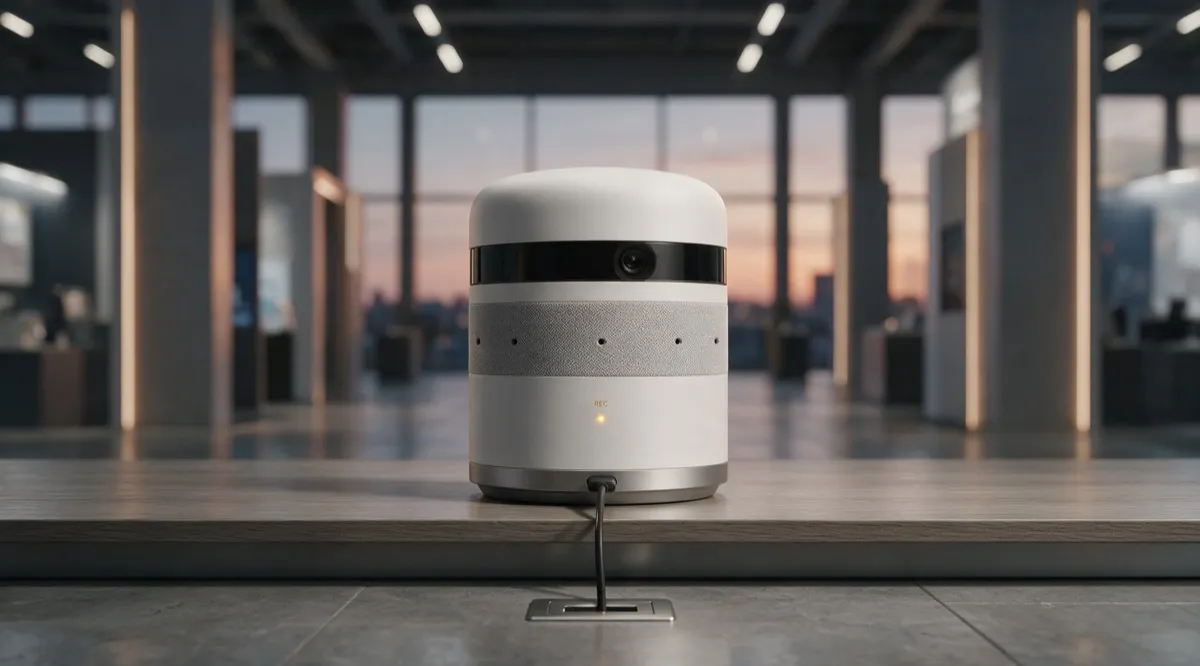
| Scailout Station | No button | Fixed to the booth counter, on booth power. A design fact, not a measured result | This site |
Two things about that table matter more than the ordering. The first is that the products at the top and the products at the bottom are not competitors, they are different categories answering three different questions, and reading the table as a ranking is the mistake it is designed to prevent. The second is that four of the nine rows contain a published price and three contain the words “not described,” which is roughly the state of documentation in this market.
Bee’s page carries the strongest processing statement anyone in the set publishes: “We never store audio recordings,” alongside “Processed in real-time” and “Immediately deleted after processing.” That is quoted here in full because it is unusually specific and because paraphrasing it would weaken a claim its author chose to make strongly.
The number that says the action gets skipped
One person counted. Bob Milam ran informal exit interviews at an Institute of Food Technologists show, asking departing attendees a single question: did an exhibitor promise to follow up with you. The count is the only field observation in this space that came from asking people rather than estimating.
Recorded by Zuant, 850 attendees said a follow-up had been promised. Fewer than 150 of those promises had been written down anywhere. Seven hundred conversations reached the point of a commitment and left no trace of it behind, hours before anyone could have failed to follow up.
Milam’s fix is the part usually left out, and it is the part that belongs in a post about start mechanisms. He appointed what he called a Lead Sheriff, a person whose entire job was to walk the booth and make sure promises got captured. Recorded promises went from about 150 to more than 700 in a single year.
That is not a discipline story. It is a staffing story. The labor did not become easier or smaller; it was moved to a person who had no competing conversation to attend to. Every product in the table above puts that same labor back on the person who does have one, and the products differ only in how much of it they ask for. We wrote about the earlier version of this failure in the note field that was always empty, and the mechanism is identical: the action is small, the moment is not.
The window that assumes somebody is free
momencio argues that the practical window for capturing what was said runs 60 to 90 seconds after a visitor walks away. That is momencio’s own assertion, published on momencio’s blog, with no study behind it. It is repeated here because it is the figure the category argues over, not because anyone has established it.
Grant the number anyway. A 60-to-90-second window is a claim about how fast a memory decays, and it says nothing at all about who is available while it does. At a busy counter that interval is already occupied by the next visitor, by a colleague asking who that was, by the badge that needs scanning before the person is out of reach.
Every product that cites the window then proposes the same remedy: a faster interface for the person who did not have time for the slower one. Speech-to-text is faster than typing. A watch is faster than a phone. A pendant is faster than a watch. The sequence has a limit, and the limit is that all of them still require the person in the conversation to do something during the conversation.
That is the question to put to a supplier directly rather than to a comparison table, and it sits alongside the nine questions we take into a vendor meeting. Ask what the product does when the person forgets. Most published pages do not answer it.
The device that removed half the decision
One product in the set took a different position, and it is worth naming precisely because it is no longer for sale. The Limitless Pendant’s own FAQ describes capture as continuous by default: “You can record all the time with the option to pause/stop recording when needed.” A person can still stop it. Nobody has to start it.
Limitless published a second decision in the same document, about the indicator rather than the button: “For privacy reasons, there is no way to dim or turn off the light entirely.” Wear guidance on the same page tells owners to wear the pendant “with the light facing outward.” Two design choices, both published, both removing an option from the person wearing the device.
The status of the product has to travel with the citation. Limitless states “We are no longer selling the Pendant as of December 5, 2025,” and that it “will continue to support existing Pendant customers throughout 2026.” Service ended on 5 December 2025 in Brazil, China, the EU, Israel, South Korea, Turkey and the UK, with a data download deadline of 19 December 2025. A reader in Seoul, London or Berlin cannot buy this device and could not have kept using it. The CEO’s note on the company’s homepage reads, “I’m excited to share that Limitless has been acquired by Meta.”
So the most interesting start mechanism in the category currently belongs to a discontinued product in seven markets. That is a fact about availability, not about quality, and it is the reason a continuous-capture position is currently easier to find in an FAQ than in a shop.
Where the list ends
At the bottom of the sorted list there is a row with nothing in the start column. Scailout Station has no button, sits on the booth counter, and runs on booth power. Nobody wears it, nobody starts it, nobody stops it, and nobody charges it overnight. That is where the list ends, and the list is the whole claim.
It is important to say what that is not. It is not a claim that the device captures more, or captures better, or misses less. We have measured nothing in an exhibition hall, so there is no accuracy figure, no pickup range, no microphone count and no speaker-separation result on this page or anywhere else on this site. Plaud publishes 9.8 feet and 16.4 feet for its products. Our cell is blank, and a blank cell is the honest entry.
What a fixed position does change is what the product can reach at all, which cuts in both directions and which we set out in the distance limit is the feature and in what booth-fixed capture cannot do. A counter-mounted device hears a counter. It does not hear the hallway, the reception, or the conversation that continues on the walk to the coffee stand, and the same fixed geometry that makes two conversations at one booth a design problem worth working on is also what draws the boundary around it.
The rest follows from the same rule we described in the best device is the one you never wear. If nobody starts the capture, the duty of announcing it cannot land on a staffer either, which is why the recording indicator has no off switch. Otter tells its users to “always announce that you are recording,” and Blinq tells its users, “You are responsible for getting consent from everyone you speak with while capturing a Notetaker Note,” and even supplies the script: “Mind if I record our chat using Blinq AI Notetaker?” Both of those are instructions to a person. An object that says it by existing is a different mechanism, and mechanism is as far as this post goes.
Nobody presses anything. That is the end of the list, not the end of the argument.